

Cylinder · lock · security
Changing a lock cylinder: when, which one and what it costs
Moving in, lost keys, a worn lock, or simply wanting to sleep better: a new cylinder (sometimes called the barrel) is often the easiest way to secure a door without replacing the whole lock. Send us a photo of your lock on WhatsApp and we'll reply with options and a fitted price.
- Price quoted = price paid
- Itemised invoice for your insurer
- Emergency: on site within 2 hours, anywhere in Luxembourg
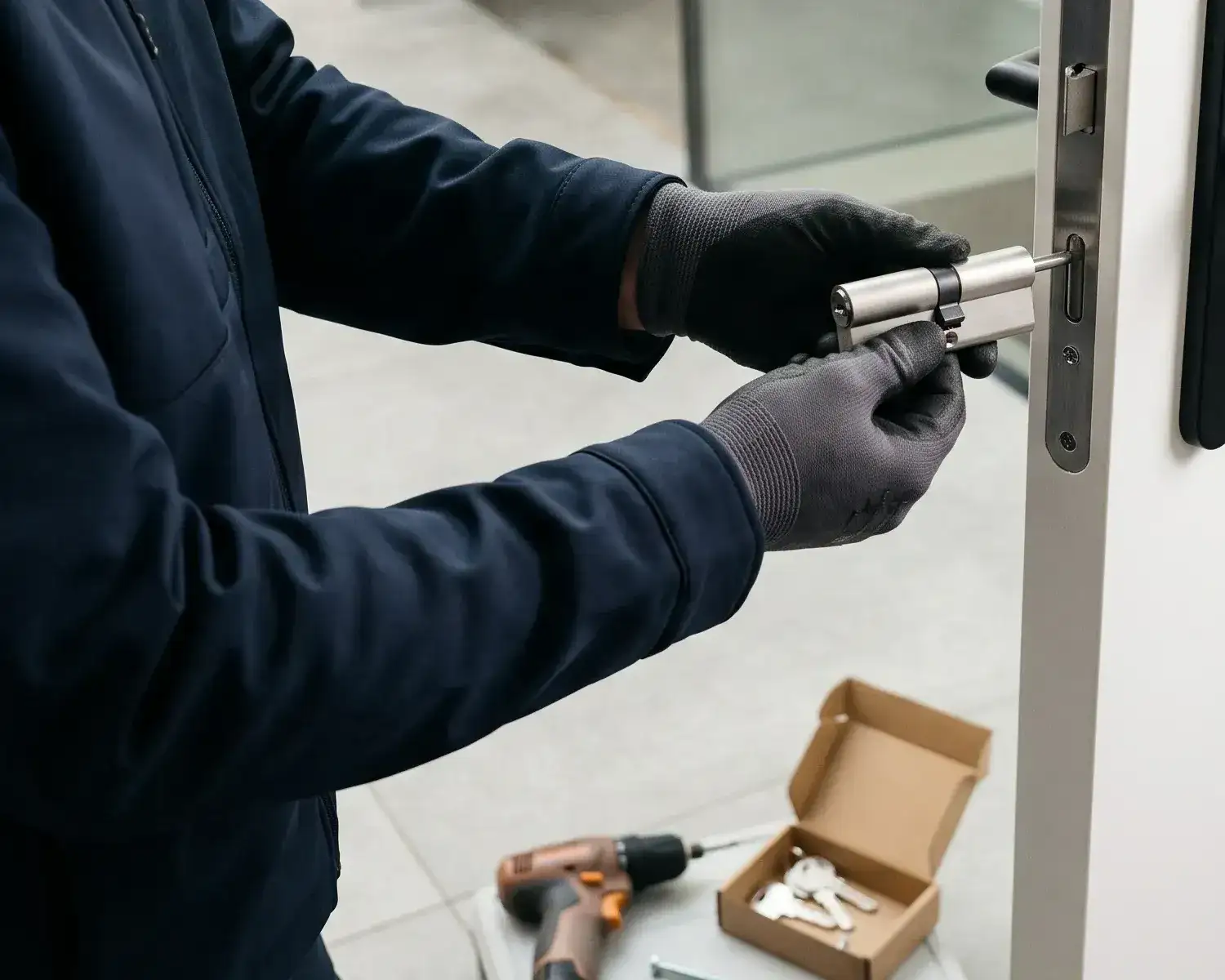
How we change your lock cylinder
On a standard front door, changing a cylinder is a short job. The technician always works in the same order and will show you each step if you'd like.
- Measure: they measure the old cylinder in millimetres, from the fixing screw hole to each end (A on the outside, B on the inside).
- Remove the screw: with the door open, they take out the fixing screw on the edge of the door, in the lock's faceplate.
- Pull out the old barrel: they put the key in, turn it slightly until the cam lines up with the cylinder body, then slide the cylinder out of the lock.
- Fit the new cylinder: they slide it in, refit the screw without overtightening, and check it doesn't stick out too far on the outside.
- Test: every key is tried on both sides, door open and then closed, and the bolt must throw and retract smoothly.
On a 3-point or multipoint lock it works the same way: the cylinder is changed without taking the rest of the lock apart.
When should you change a lock cylinder?
- After moving in: you don't know how many copies are out there. More on this below.
- After losing your keys or having them stolen, especially if your address was with them.
- After a burglary or attempted break-in: a forced or snapped cylinder no longer protects you. See after a break-in.
- When the key sticks or is hard to turn even though the door is well adjusted: the barrel is worn.
- When a key has broken inside the cylinder and can't be removed cleanly. See key broken in the lock.
- To upgrade: moving to an anti-pick, anti-snap security cylinder, or one with a key control card.
Standard, high-security or with a key control card
Three families for three needs. We show you the available models and their prices before fitting anything.
Standard cylinder
For internal doors, cellars, garden gates.
- Basic protection against picking
- Easy to copy keys
- Cheapest
High-security cylinder
For the front door of a flat or house.
- Better resistance to picking, drilling and snapping
- High key-security grade under EN 1303
- Often required or recommended by insurers
Cylinder with key control card
For rented property, shops, or after losing keys.
- Copies only cut on presentation of the card
- You know exactly how many keys exist
- Most expensive, most controlled
Measuring a euro cylinder before replacing it
A new cylinder has to match exactly. You don't measure the overall length but two distances, both taken from the centre of the fixing screw: A towards the outside and B towards the inside. Two cylinders with the same total length can have different A and B sizes.
On the outside, the cylinder shouldn't stick out more than a few millimetres beyond the escutcheon or handle plate: anything that protrudes gives a burglar something to grip and snap. If your door has a security plate, we take it into account.
Not sure about your measurements? Send a photo of the door edge and of the cylinder from the front: we check before coming, and the technician measures again on site anyway.
Rapide, efficace : j'ai perdu ma clé et ils sont venus en moins de 2 h. Ils ont changé ma serrure rapidement, proprement et efficacement.
Standards worth knowing
- EN 1303: the European cylinder standard. Its code shows key-related security (1 to 6) and attack resistance (0 to D), among other things.
- EN 1627: burglar resistance of the whole door set (door, frame, hardware), RC1 to RC6. A great cylinder in a weak door isn't enough.
- VdS: German certification used as a reference by many insurers.
- A2P: French certification issued by CNPP, one to three stars.
Your home insurance may require a minimum level. Check before choosing: that's what counts if you ever make a claim. To compare models, see our guide to choosing a security cylinder.
What a lock cylinder replacement costs
The price covers the part and fitting. It mainly depends on the security level and the cylinder's measurements, which must match your door thickness.
For an accurate remote price, send us on WhatsApp a photo of the lock from the front and, if you can, the edge of the door where the fixing screw is. The quote is free: we reply with a fitted price including 17% VAT.
- Photo on WhatsApp — Lock from the front, door edge if possible.
- Options and fitted prices — One or more suitable cylinders, each with its price including VAT.
- Fitting — The technician measures, fits and tests the cylinder with you.
- Keys handed over — All the keys, the key control card if any, and a detailed invoice.
Changing a cylinder yourself: when it's realistic
It's doable if you're inside with the door open, and you have your keys and a cylinder with the right measurements: a screwdriver is all you need. Same order as above, and test it with the door open before closing it. Full steps in our guide how to change a lock cylinder.
Call a locksmith instead if:
- you're outside without a key: the door has to be opened first, see locked out;
- the cylinder won't come out even with the screw removed, or the screw is seized;
- the lock has been forced and the faceplate or lock case is bent;
- you're unsure about the model or the measurements: the wrong cylinder gets bought twice.
After moving in: why change the cylinder
You never know how many copies of your keys are out there: previous tenants, tradespeople, neighbours. A new cylinder costs far less than a burglary with no sign of forced entry, which insurers are often reluctant to cover.
If you rent, talk to your landlord or agency first. When you leave, you can refit the old cylinder or leave the new one, as agreed.
What happens after you call
- 01
You call or message
By phone or WhatsApp. A photo helps us understand straight away.
- 02
Price and time up front
Before we set off. The price quoted is the price you pay. You decide — no commitment until you say yes.
- 03
Work explained
The technician explains the work and leaves the place clean. Photos of the job on request.
- 04
Itemised invoice
A clear invoice, ready for your insurer.
Frequently asked questions
How much does it cost to change a lock cylinder?
It depends on the security grade and the measurements. Our starting prices are in the table above and on the prices page. Send a photo: the quote is free and the fitted price is given before we travel.
Can you change a cylinder without the key?
Without the key the cam can't be lined up, so the cylinder won't come out the normal way. That's a job for a locksmith: the old cylinder is usually destroyed and replaced. We ask for proof that you live there first.
How do you replace the barrel on a multipoint lock?
Just like a single lock: fixing screw on the door edge, key turned to line up the cam, then the barrel slides out. Often only the size differs, as these doors are thicker. Measure A and B carefully, or let us measure.
Can I supply my own cylinder?
Yes, as long as the measurements match your door. We quote the fitting price in advance. Send us the reference or a photo first.
Does the landlord or the tenant pay?
It depends on the reason and your lease. Wear and tear often falls to the landlord, lost keys to the tenant. If in doubt, ask before the job.
Do I need to replace the whole lock?
Rarely. Usually only the cylinder. We replace the whole lock only if it's broken or too weak for your door, and then handle the lock installation.
How many keys do I get?
It depends on the model. We tell you along with the price.